Haptic Cues for Unusual Flight Attitude Recovery
Evaluating bone-conduction haptic feedback for pilot recovery from unusual flight attitudes | HFES 2024
Overview
This research investigated whether bone-conduction haptic feedback could help pilots recover from unusual flight attitudes—dangerous situations where an aircraft is in an unintended pitch or roll orientation. We tested whether tactile spatial cues could supplement or replace visual information during recovery maneuvers.
Research Question
Spatial disorientation remains a leading cause of aviation accidents, particularly when visual cues are degraded or ambiguous. We asked: can haptic cues improve pilot recovery from unusual flight attitudes, and does their effectiveness depend on visual conditions?
Intervention Design
We developed a bone-conduction haptic device worn on the head that activates when the aircraft exceeds safe attitude thresholds (pitch +25°/-10° or roll ±45°). The haptic mapping used a simple mental model: users move "away" from the vibration to return to straight and level flight. For example, tapping on the forehead indicates the nose is too high—pull the stick aft to correct.
This approach builds on prior spatial orientation research while prioritizing intuitive interaction design that requires minimal training.
Experimental Design
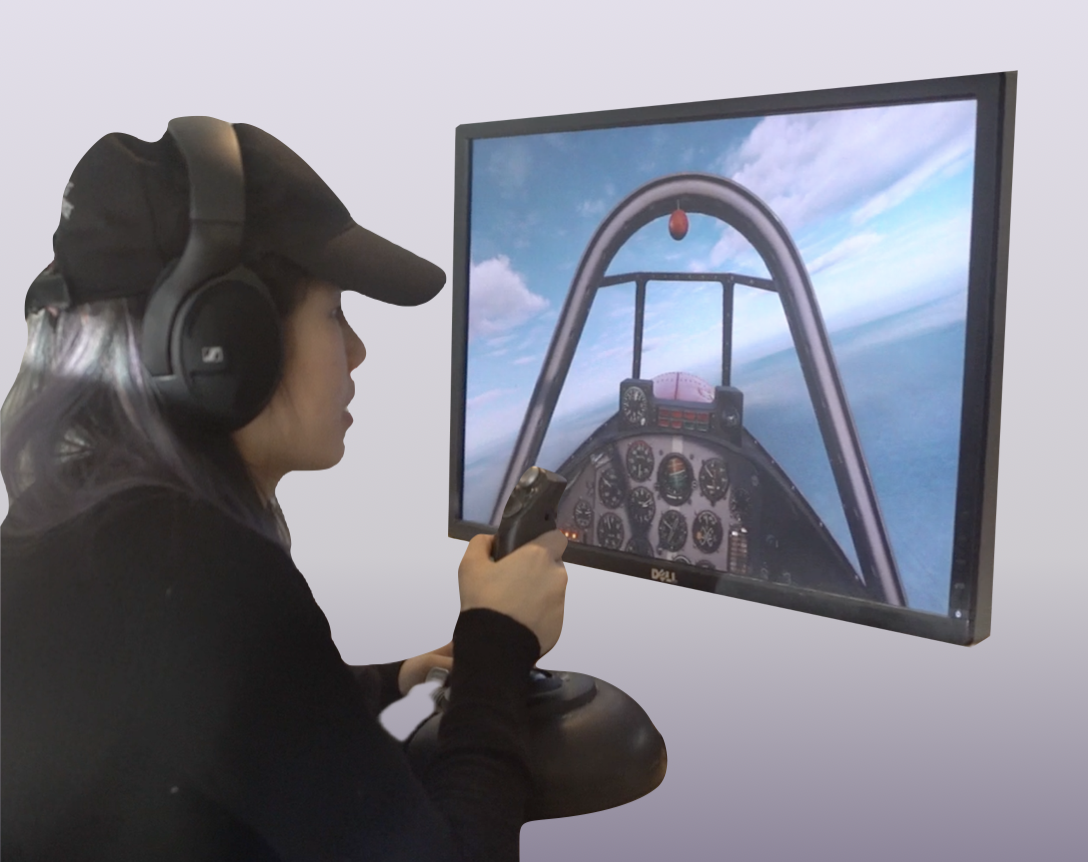
Seven participants, including two certified flight instructors and one with fighter jet training, completed trials in a Digital Combat Simulator using realistic flight controls. Each participant experienced four conditions in counterbalanced order:
- Visually clear (day) / No haptic
- Visually clear (day) / Haptic device
- Visually degraded (night) / No haptic
- Visually degraded (night) / Haptic device
For each condition, participants corrected three different unusual attitudes, completing twelve trials total. We measured recovery time and subjective workload using the NASA TLX assessment.
Key Findings
The results revealed no significant difference in overall recovery times with haptics (μ = -0.36s, σ = 1.44, p = 0.892) or workload (μ = -5.75, σ = 5.52, p = 0.171). However, the effect of haptics showed substantially more variance during visually degraded conditions, suggesting individual differences in how pilots integrate multimodal spatial information.
Qualitative feedback was striking: participants found the haptics annoying during clear visual conditions but helpful at night when visual references were ambiguous. This suggests haptic cues should be context-dependent—activating only when primary sensory channels are compromised.
Unexpectedly, we found that mental representation significantly impacted performance. Participants who framed the haptic device as something negative to avoid (like a bee) showed better outcomes than those who viewed it neutrally. This suggests that effective sensory augmentation may require not just intuitive mappings, but emotionally salient ones.
Design Implications
This work highlights two important considerations for sensory augmentation systems:
- Context-aware activation: Augmentation should adapt to environmental conditions, providing information only when primary senses are insufficient
- Mental framing matters: The cognitive model users adopt—even implicitly—can be as important as the technical mapping itself
These findings inform ongoing work on multimodal feedback for complex spatial tasks, from teleoperation to navigation under sensory-degraded conditions.
This research was presented at HFES 2024.
For more information, please read the paper or see the poster.